
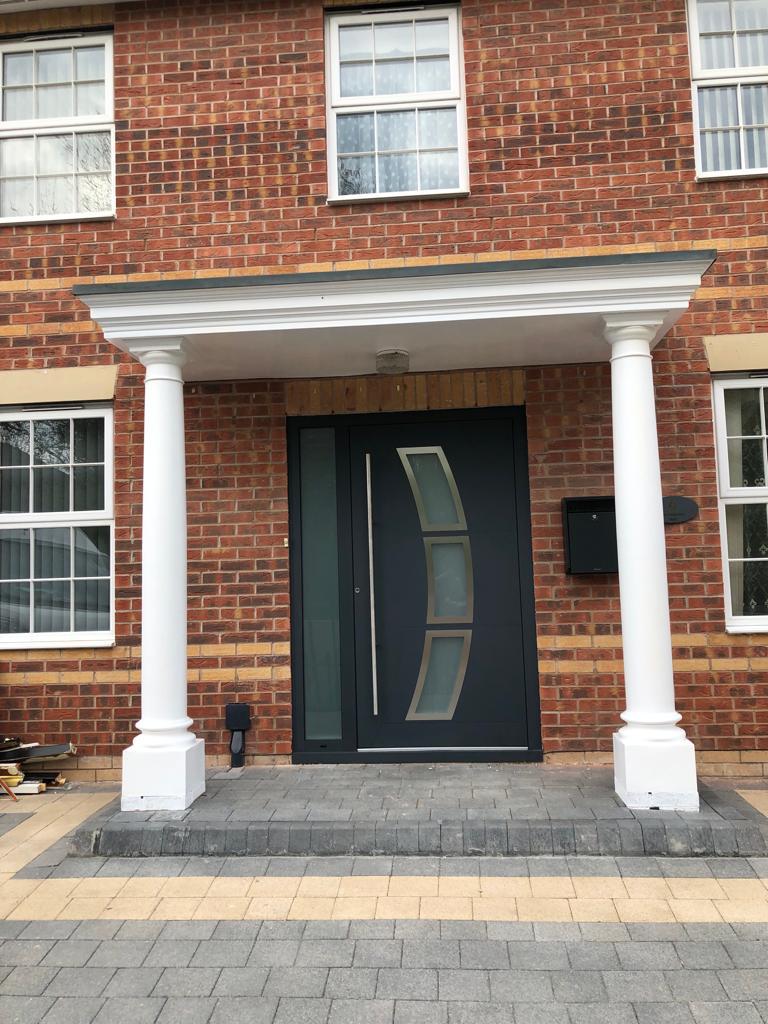
A black front door is one of the most reliable ways to smarten a house. It reads as formal and traditional on a Georgian or Victorian terrace, sharp and graphic on a modern home, and works against red brick, stock brick and white render alike. The choices that make or break it are the exact black, the finish, the hardware, the glass and, on a sunny elevation, the material. We supply and fit black composite, aluminium and UPVC front doors across Berkshire, Buckinghamshire, Surrey, west Kent and north West Sussex.
For a wider look at front door materials, see our front doors guide. For black windows to match, see grey and black windows.
Which black?
“Black” covers more than one shade. True black, such as RAL 9005 Jet black, gives the deepest, most formal look. Near-blacks such as RAL 7021 Black grey are softer and slightly less stark in bright light, and can sit better beside anthracite grey windows. On aluminium we powder coat to a RAL colour; on composite and UPVC, black comes as a set colour or foil, so ask us and we’ll confirm the exact shades available for your door.
Finish
- Smooth or satin: the classic painted-door look, ideal for period panelled designs.
- Woodgrain texture: suits cottages and boarded styles; the grain catches light so the black looks less flat.
- Matt or fine-textured: on aluminium, a contemporary finish that hides minor marks.
“Professional service, good communication and attention to detail throughout the job. The finished work looks fantastic and was exactly what I needed.”
“Everything from the sales to the installation was a perfect experience. We love our sliding doors and windows.”
“Excellent work done in installing the new door. Price was very competitive. Would highly recommend.”
Period or modern?
On period houses, black has long been a favourite. A four-panel black door with a brass knocker and letterplate is the archetypal London-style terrace entrance, and the look translates well to Victorian and Edwardian homes in Windsor, Reading, Guildford or Tunbridge Wells. See our period doors guide for panel layouts.
On modern houses, black works best on a flush or near-flush door with a long bar handle and a slim strip of glass, ideally framed by black or anthracite aluminium windows. A black door with glazed side panels in a black frame makes a strong single composition.
Hardware pairings
- Brass or gold-tone: warm and traditional; the classic pairing for a period black door.
- Polished chrome or satin stainless: crisp and bright; suits both Edwardian and contemporary doors.
- Black on black: minimal and modern, but can look flat; it works best where the door has texture, glazing or a strong handle shape to break up the surface.
- Pewter or antique-effect: softer than chrome; good on cottages.
Our door handles guide covers security ratings, which matter whatever the finish.
Black doors against brick and render
- Red brick: black gives sharp contrast; brass furniture adds warmth.
- Yellow stock or buff brick: black looks smart and slightly formal; chrome keeps it fresh.
- White or cream render: the strongest contrast of all; consider black windows too for a unified look.
- Flint, tile-hanging and timber cladding: common in Surrey, Sussex and Kent villages; a woodgrain black door suits these textures better than a high-gloss one.
- Mock Tudor: black picks up the black timbering; keep hardware traditional.
Heat: the caveat with dark doors
Dark colours absorb more sunlight and get hotter. In tests reported by Glass Times, a standard white PVC-U profile ran about 20 to 22°C above ambient in sunlight, while a black coated surface reached about 44°C above ambient. The article explains that higher heat build-up means more expansion, which in PVC-U can soften and distort the profile, and mixing materials with different expansion rates can make a door bind or lock poorly. It also describes infrared-reflective “cool colour” coatings that bring dark finishes much closer to white.
What this means for you:
- On a south or west-facing door in full sun, talk to us about material choice; aluminium does not soften at these temperatures the way PVC-U can.
- Ask whether a dark composite or UPVC door uses a heat-reflective finish, and check the manufacturer’s guidance for dark colours.
- Expect handles and the door face to feel hot on summer afternoons.
- A canopy or porch shades the door and makes a real difference; see our porches page.
Glass and light
A black door makes a hallway feel darker if it is solid. Glazed panels, side lights or a toplight balance it. Clear or lightly textured glass looks best in black frames; very dark tinted glass alongside a black door can make a north-facing hall gloomy.
Inside the house
Many doors can be ordered with a different colour on the inside, so a black exterior can still open into a white or light hallway. Decide this at order stage.
Planning and conservation areas
Changing door colour is normally fine, but in some conservation areas an Article 4 direction can bring exterior painting and door alterations under planning control (example from West Northamptonshire Council), and the Planning Portal advises checking with your council where extra restrictions may apply. Black is rarely controversial on period streets, but check first.
Common mistakes
- Choosing jet black next to anthracite windows without comparing samples in daylight.
- Skimpy hardware that disappears on a large black door.
- Ignoring a south-facing elevation when choosing the material.
- A solid black door into a hall with no other natural light.
Caring for a black front door
Dust, salt and water marks show more on black than on mid-grey, so wipe it with a soft cloth and mild soapy water every few weeks and dry it off to avoid streaks. Avoid abrasive pads, which dull the finish.
See black doors at a free survey
We bring finish samples so you can see the shades against your own brick or render. All doors carry our 10-year guarantee. Call 01753 965 005 or request a quote online.
Frequently asked questions
Do black front doors get too hot in the sun?
They get hotter than light colours. Industry tests have shown a black surface running roughly twice as far above air temperature as white PVC-U. On a south or west-facing door, consider aluminium, ask about heat-reflective finishes on composite or UPVC, and think about a canopy. Handles can also feel hot on summer afternoons.
What handles go best with a black front door?
Brass or gold-tone hardware gives a warm, traditional look suited to period homes. Chrome or satin stainless is crisp and works on both Edwardian and modern doors. Black-on-black is minimal but can look flat unless the door has texture or glazing. Keep all furniture, including the letterplate and hinges, in one finish.
Does a black front door suit red brick?
Yes. Black gives strong contrast against red brick and looks smart on everything from Victorian terraces to modern estates. Brass hardware adds warmth, while chrome keeps it crisp. If your windows are white, a black door still works well; for a more unified look, consider black or anthracite windows.
Can I have a black front door that is white inside?
Often, yes. Many front doors can be ordered with one colour outside and a different colour inside, so a black exterior can open into a white or light hallway. This needs to be specified when the door is ordered, so mention it at survey and we will confirm what is available for your door.
Is jet black the same as black grey?
No. RAL 9005 Jet black is a true, deep black, while RAL 7021 Black grey is a very dark grey that looks softer in bright light. Black grey can sit more comfortably beside anthracite grey windows. Compare samples in daylight against your brickwork before deciding, because the difference is clearer outdoors.