
Door furniture is everything you touch or see on a door: the handles, letterplate, knocker, house number, spyhole and lock cylinder. On a new front door the choice is usually between a lever handle on both sides, a lever inside with a fixed pad outside, or a long pull bar on a contemporary aluminium door, finished in chrome, satin, black or brass effect. If you want a smart lock, decide before the door is ordered, because compatibility depends on the lock mechanism, cylinder and door thickness. We supply and fit doors with matching furniture across Berkshire, Buckinghamshire, Surrey, west Kent and north West Sussex.
For door styles and materials start with our front doors guide. This page covers the hardware.
Handle types
Lever and lever
A lever on each side. Lifting either lever engages the multipoint lock, and pushing down opens it once unlocked. Common on back doors and many front doors. The drawback on a front door is that, if you leave it on the latch, anyone can push the outside lever down and walk in.
Lever and pad
A lever inside and a fixed pad or knob outside. From the street the door can only be opened with a key, so it cannot be left accidentally openable. You lift the inside lever to lock, or use the key outside. A sensible default for most front doors.
Pull bars and D-handles
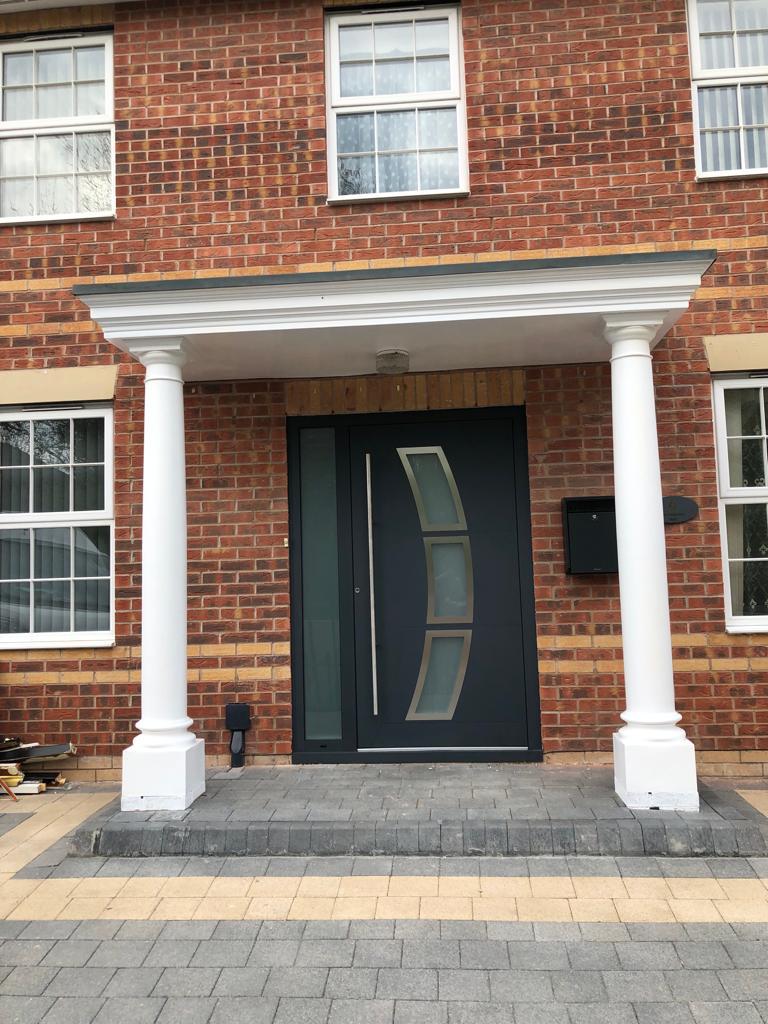
Long vertical bars, usually on contemporary aluminium doors, sometimes running most of the door height. They make a strong design statement and are easy to grab with full hands. Locking is by key or thumbturn, and sometimes a separate inside lever. Choose a length in proportion to the door; a bar that is too short looks like an afterthought.
Centre knobs
A traditional fixed knob placed in the middle of the door at waist height, used on Victorian and Georgian-style doors. It is decorative and for pulling the door shut; the lock works from a separate handle or cylinder. See our period doors guide.
“Professional service, good communication and attention to detail throughout the job. The finished work looks fantastic and was exactly what I needed.”
“Everything from the sales to the installation was a perfect experience. We love our sliding doors and windows.”
“Excellent work done in installing the new door. Price was very competitive. Would highly recommend.”
Security ratings for handles and cylinders
The handle and cylinder work as a pair. A cylinder rated TS 007 1-star is not tested against snapping, but combined with 2-star security handles that shroud the cylinder it reaches the 3-star level; a 3-star cylinder achieves it on its own (Master Locksmiths Association). Police also advise that the cylinder should not stand more than 3mm proud of the furniture (West Yorkshire Police). If you change handles later, keep the rating: a decorative handle without a security rating can undo the protection of a 1-star cylinder.
Handles must also match the lock’s spindle and cylinder positions (the “centres”) and the door thickness. Mismatched aftermarket furniture is a common cause of stiff locks.
Letterplates
- Position: traditionally on the mid-rail of a panelled door; on contemporary doors often low or vertical, or replaced by a wall-mounted box.
- Security: a letterplate tested to DHF TS 008 resists key fishing and reaching through (DHF).
- Draughts: an inner flap or brush seal and a cowl cut draughts and stop post being snatched back out.
- Alternative: on highly insulated or very secure doors, some people omit the letterplate and fit an external post box instead.
Knockers, numerals, spyholes and chains
Knockers suit traditional doors, usually above the letterplate at roughly eye level. House numbers can be fixed to the door, the glass or the toplight. A door viewer is worth adding if you have no side glass, and a chain or restrictor helps when checking callers, though police note neither protects a locked door from a break-in.
Finishes that last
Chrome and polished finishes look crisp but show fingerprints; satin and brushed finishes are more forgiving. Black suits cottages, black doors on modern houses and grey doors; brass and gold-tone suit deep heritage colours. Keep everything on the door in one finish, including hinges and letterplate, and wipe furniture occasionally with a soft damp cloth rather than abrasive cleaners. See our black front doors and grey front doors guides for pairings.
Smart locks for front doors
Smart locks let you lock and unlock from a phone, fob or keypad and see when the door was used. On UK UPVC and composite doors they generally come in three forms:
- Retrofit units that fit over the inside of the euro cylinder and turn it with a motor.
- Smart cylinders that replace the standard euro cylinder.
- Motorised or automatic multipoint locks built into the door at manufacture.
Compatibility caveats
- Lift-to-lock doors: on most multipoint doors the hooks or bolts only engage when the handle is lifted. A retrofit motor that turns the cylinder cannot lift the handle, so you may still have to do that by hand before it can lock fully. Check the product is designed for your lock type.
- Cylinder size and cam: retrofit kits need the right cylinder lengths and cam type; one guide notes typical composite cylinders of 35/45mm or 40/50mm and advises measuring before buying (smart lock guide for composite doors).
- Door thickness: thicker doors may need longer cylinders, which must still sit within 3mm of the handle.
- Signal: a dense door or a metal frame can weaken wireless signal, so check hub or Wi-Fi range.
- Batteries: make sure there is a reliable key override.
Insurance
Insurers generally expect a traditional approved lock alongside a smart lock, because many smart locks are not approved on their own, and you should tell your insurer before fitting one, according to Allianz. Some newer models meet standards such as BS 8621 or PAS 3621. Whatever you choose, keep the anti-snap cylinder rating.
If you plan to add a smart lock, mention it at survey. Ask us and we’ll confirm which lock and cylinder arrangements are available on the door you choose, so the door suits it from day one. Our door security guide explains the ratings in more detail.
Common mistakes
- Lever and lever on a front door that is often left on the latch.
- Replacing security handles with unrated decorative ones.
- Buying a smart lock before checking cylinder length and lock type.
- Mixing finishes, such as chrome handles with a brass letterplate.
Get advice at a free survey
We bring hardware samples so you can feel the handles in your hand. Every door we fit comes with our 10-year guarantee. Call 01753 965 005 or request a quote online.
Frequently asked questions
Should my front door have a lever or a pad handle outside?
For most front doors, a lever inside with a fixed pad or knob outside is the safer choice. The door can only be opened from outside with a key, so it cannot be left accidentally openable on the latch. Lever and lever handles are convenient on back doors that are opened constantly during the day.
Can I fit a smart lock to a UPVC or composite door?
Usually, but check compatibility first. Most multipoint doors need the handle lifting to engage the lock, which a retrofit motor cannot do, and smart cylinders need the right lengths and cam type. Motorised multipoint locks built in at manufacture avoid these issues. Mention a smart lock at survey so the door suits it.
Will a smart lock affect my home insurance?
It can. Insurers generally expect a traditional approved lock alongside a smart lock, because many smart locks are not approved on their own, and you should tell your insurer before fitting one. Keep your anti-snap cylinder rating too. Some newer smart locks meet recognised standards, but always check your own policy wording.
What security rating should door handles have?
If your cylinder is TS 007 1-star, fit 2-star security handles, which together reach the 3-star level that resists snapping. With a 3-star or Sold Secure Diamond cylinder, the handle rating matters less, but the cylinder should still not protrude more than 3mm beyond the handle. Avoid unrated decorative handles.
Do I need a letterbox in my front door?
Not necessarily. A letterplate is convenient, but it can let in draughts and be used to fish for keys. If you have one, choose a letterplate tested to DHF TS 008 or add an internal cowl. Some people choose a solid door and fit an external post box instead, especially on contemporary doors.