
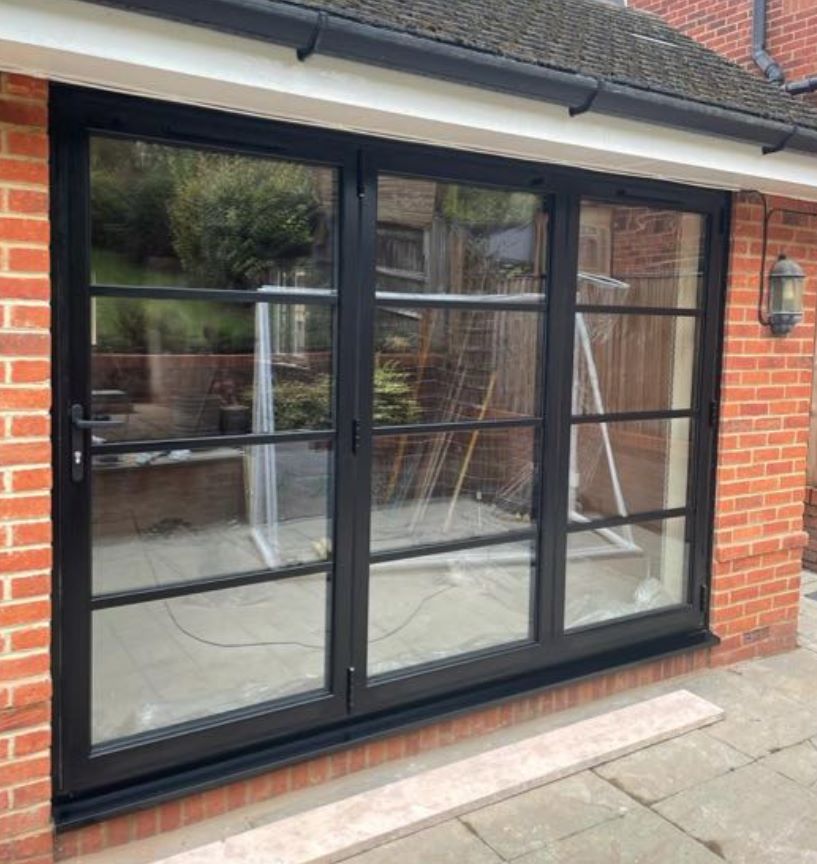
Inspired Glazing makes and fits aluminium bifold doors in Richmond using the Smart Systems Visofold 1000 and the Cortizo folding system, all fabricated in our Fifield workshop and installed by our own team. A folding door is a natural fit for the town’s Victorian villas and family terraces, opening a kitchen extension fully onto the garden. Lead times start from 10 days, and every installation comes with a 10-year guarantee.
Free survey for bifold doors in Richmond
Made in our own Fifield workshop and fitted by our own team, with lead times from 10 days and a 10-year guarantee. Tell us about your opening and we will book a free survey.
Richmond homes and how they open up
Richmond has a wide mix of housing: ornate Victorian houses with canted bays along streets like Park Road, red-brick terraces and cottages around Old Palace Lane, and larger villas on the slopes of Richmond Hill. Many have been extended at the back or into the side return. On those extensions, a folding door opens the room almost completely, so a terrace and lawn become part of the house on a warm evening.
For extensions with two garden-facing sides, two folding runs meeting at a corner post can open both elevations. The structure above determines whether this is practical, so ask us to confirm for your opening once your builder or engineer has a design.
Visofold 1000 and Cortizo compared
The Smart Systems Visofold 1000 is our most frequently fitted folding system. It takes sashes up to 1,200 mm wide and 2,500 mm high, uses PAS 24 approved roller and top guide hardware, and can be made in dual colour. Its frame depth is 70 to 82 mm, and glazing options run from 24 mm to 38 mm.
The Cortizo folding system handles taller openings, with leaves up to 3,000 mm high and 120 kg each, and has passed PAS 24 testing. For a full comparison, see our Visofold vs Cortizo bifold doors article, and for finishes and layouts visit the aluminium bifold doors hub. Our Cortizo windows and doors page covers matching windows.
Conservation areas and Article 4 in Richmond
The London Borough of Richmond upon Thames has many conservation areas, including Richmond Riverside and Richmond Green, and uses Article 4 directions to bring changes such as extensions, new doors and windows under planning control. In Richmond town, directions cover streets including The Vineyard, Mount Ararat Road, Montague Road and Townshend Road. Check with Richmond upon Thames Council for your address before you design an extension or a new opening, and read our planning permission guide for the general picture.
Flats, including those in converted villas and riverside mansion buildings, have no permitted development rights, and the freeholder or managing agent will usually need to give consent as well.
Travel, parking and access
Our team travels from Fifield, about 17 miles from Richmond in a straight line, which is usually a 40 to 50 minute drive. Every opening is surveyed in person before we make anything.
Many Richmond streets have controlled parking. Richmond Council asks for several working days’ notice for a parking bay suspension, so we apply once the installation date is fixed. Terraces usually have no side access, so we plan the carry route through the house and protect floors and stairs.
Designing around the garden
Richmond gardens vary from compact courtyards behind terraces to long lawns behind detached houses, and the right door depends on how you use the space. We look at where the panels will stack, whether a traffic door is needed for daily use, and how the threshold meets the patio. In gardens with large trees, falling leaves can collect in the bottom track, so we position drainage carefully and explain how to keep it clear. For a south or west-facing extension, solar control glass is worth considering to manage summer heat.
We also coordinate with your builder on the structural opening, because folding doors need a lintel or steel that will not deflect. Our team measures the finished opening before the doors are made in Fifield.
Folding or sliding by the river
If your home looks over the Thames or a long garden, a slider with fewer, larger panes may frame the view better. See our aluminium sliding doors in Richmond, or read bifold vs sliding doors for help choosing.
We also cover nearby areas, with pages for bifold doors in Kew, Mortlake bifold doors and bifolds in Chiswick.
Arrange a survey
For a free survey in Richmond, call 01753 965 005, WhatsApp us on 07934 152 343, or fill in our free quote form. The office is open from 8am to 6pm on weekdays and from 9am to 1pm on Saturdays.
Frequently asked questions
Is my Richmond street covered by an Article 4 direction?
Possibly. Richmond upon Thames Council lists Article 4 directions by street, and in Richmond town these include The Vineyard, Mount Ararat Road, Montague Road and Townshend Road among others. They can bring new doors and extensions under planning control. Use the council's conservation area lookup or contact its planning team to check your address.
Can bifold doors suit a Victorian villa in Richmond?
Yes, especially on a rear or side extension where the original house is left unchanged. Slim aluminium frames in a muted colour sit comfortably beside brick and stucco. If the house is listed or in a conservation area, check with the council first, as the design may need to be agreed.
What glass options are available for bifolds?
The Visofold 1000 accepts glazing of 24, 28, 34, 36 and 38 mm, which allows a range of double glazed units, including laminated and solar control glass. We recommend a build-up at survey based on orientation, security needs and whether the doors face a road, a garden or the river.
How long does a bifold installation take in Richmond?
Our lead time starts from 10 days after survey and sign-off. Fitting a typical set takes our team a day or two depending on the opening and finishing work. Allow time beforehand for any planning consent and for the parking bay suspension, which Richmond Council needs several working days to arrange.
Do bifold doors need much maintenance?
Very little. Keep the bottom track clear of leaves and grit, wipe frames with mild soapy water a few times a year, and check that drainage slots are free, particularly near trees or the river. Hardware can be lightly lubricated as needed. We are happy to advise on care when we hand over.